Kaihao Zhang
npj Flexible Electronics, (8), 1, 16, 2024
Abstract
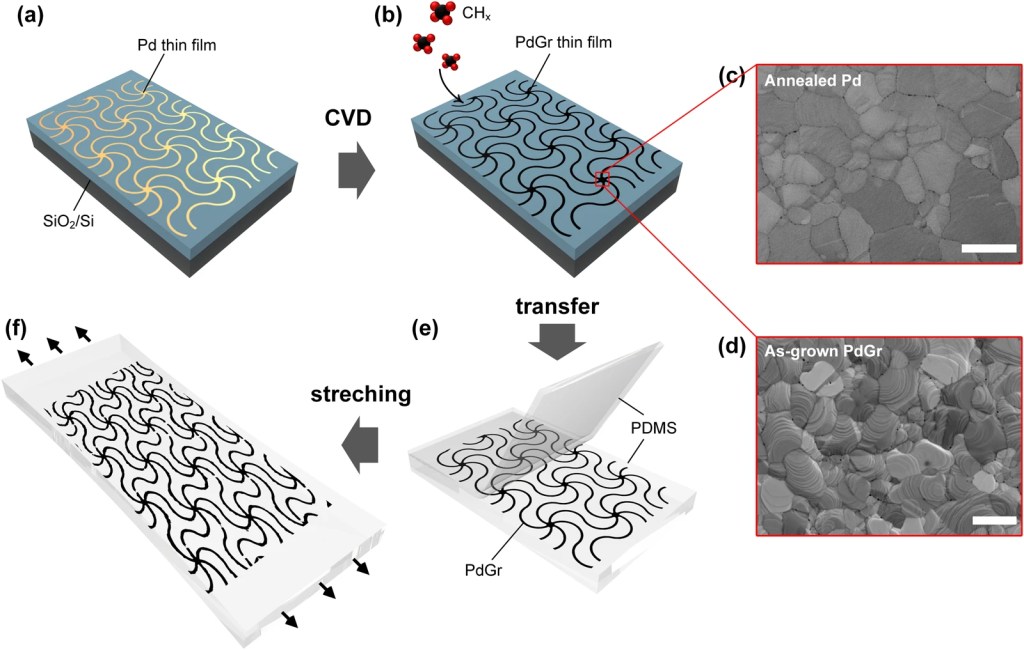
Conductive patterned metal films bonded to compliant elastomeric substrates form meshes which enable flexible electronic interconnects for various applications. However, while bottom-up deposition of thin films by sputtering or growth is well-developed for rigid electronics, maintaining good electrical conductivity in sub-micron thin metal films upon large deformations or cyclic loading remains a significant challenge. Here, we propose a strategy to improve the electromechanical performance of nanometer-thin palladium films by in-situ synthesis of a conformal graphene coating using chemical vapor deposition (CVD). The uniform graphene coverage improves the thin film’s damage tolerance, electro-mechanical fatigue, and fracture toughness owing to the high stiffness of graphene and the conformal CVD-grown graphene-metal interface. Graphene-coated Pd thin film interconnects exhibit stable increase in electrical resistance even when strained beyond 60% and longer fatigue life up to a strain range of 20%. The effect of graphene is more significant for thinner films of < 300 nm, particularly at high strains. The experimental observations are well described by the thin film electro-fragmentation model and the Coffin-Manson relationship. These findings demonstrate the potential of CVD-grown graphene nanocomposite materials in improving the damage tolerance and electromechanical robustness of flexible electronics. The proposed approach offers opportunities for the development of reliable and high-performance ultra-conformable flexible electronic devices.

 M³ Lab