J, Han, X, Zhang, Y, Wang, X, Zheng, Kaihao Zhang, J, Yang, Z, Wang, Y, Zhou
Advanced Materials, 37,21, 2025
Abstract
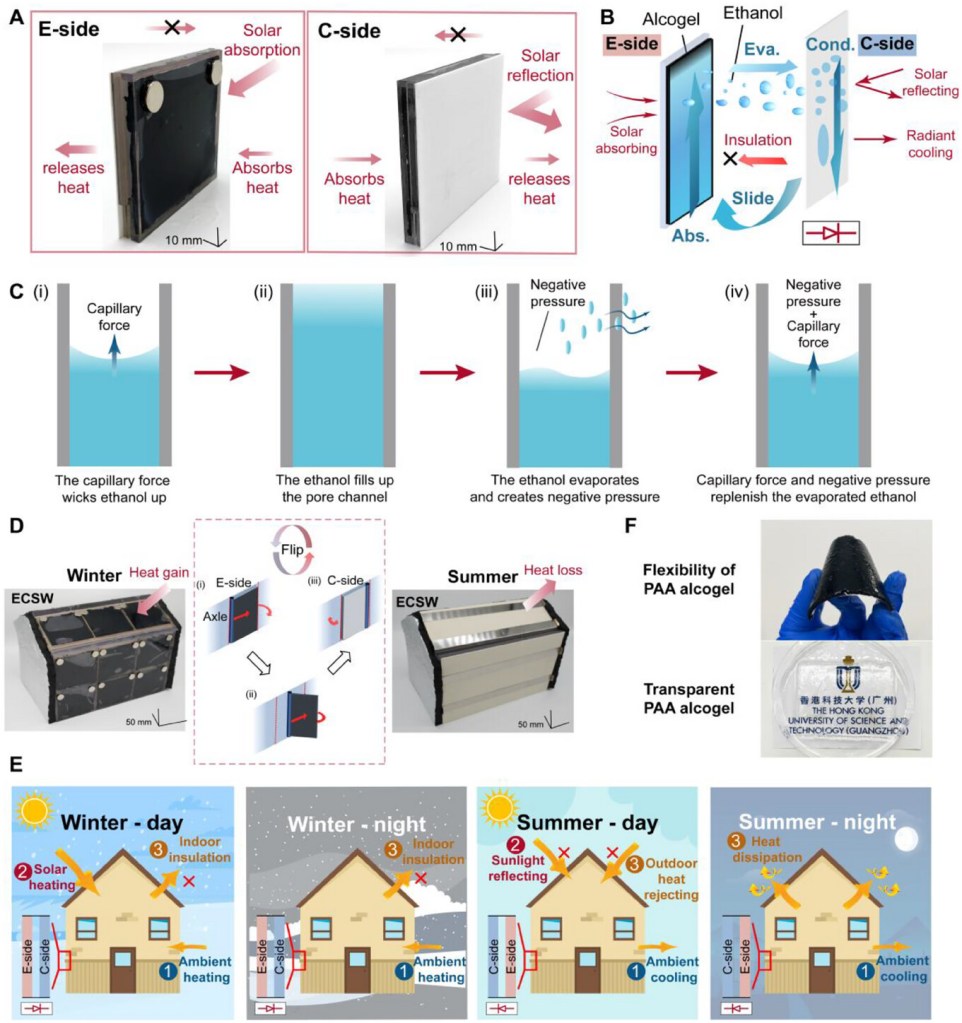
Traditional building envelopes with constant thermophysical properties constrain their capabilities in temperature regulation. Whether it is possible to achieve single-direction heat transfer along building envelopes with climate-adaptative thermophysical properties to enhance passive heat gain in winter and thermal dissipation in summer? In this work, through the capillary effect in interfacial evaporation and thermal diode structure, single-direction heat transfer with passively adjustable thermal properties in a vertical building envelope is practically achieved. An evaporation-condensation-based smart wall (ECSW) is manufactured for spontaneous and continuous cooling/heating supply to the built environment. The ECSW features climate-adaptative heat transfer characteristics with heat transfer coefficient transiting from 3.33 to ≈30 W m−2 K−1. Additionally, coupling with radiant cooling and photothermal capabilities, ECSW shows excellent thermal performances, i.e., a heat transfer at 5.44 W m−2 by radiant cooling with a 5 °C cooler surface, and a heat transfer at 387.68 W m−2 under solar illumination at 1000 W m−2. Simulation results show that the ECSW enables building energy savings at 66.47% in Kunming. This study first reports vertical thermal diode building envelopes utilizing natural heating/cooling sources through interfacial evaporation for passive temperature regulation with low costs, performance stability and energy-saving potentials for smart and sustainable buildings.

 M³ Lab